Amsoil synthetic motor oil for over 30 years

Amsoil - The first company to come out with synthetic oil for automobiles before Mobil, Royal Purple or Castrol

HomeamsoilCarsbest motor oilBoatsamsoil dealerMotorcycle Oil RV'sbest engine oilSnowmobilesmotor oilImportant Articlesamsoil synthetic motor oilTestimoniesamsoil engine oil syntheticAbout AmsoilLinksauthorized amsoil dealer for synthetic motor oilFAQFree Catalog
See who you're doing business with Get a free Amsoil catalog- Email me at:

USA, Canada & Puerto Rico
Order by phone
7AM-5PM Central
Toll-Free at:
1-800-777-7094
Give Operator ZO # 1102880

Make sure you have all of the 3-letter codes for each product handy before calling!

Contact Us

Find out how to order Amsoil Interceptor 2-cycle oil
Visit the AMSOIL
On-Line Store

Motocross Lubricants

Best 4-cycle Motorcycle Oil

Amsoil vs. Mobil 1

10 myths of
synthetic oil

What you need to know about oil additives

Synthetic oil compared to your conventional oil

The brainwashing
of consumers

Amsoil on the dyno
compared to Mobil, Castrol, Royal Purple, Torco,
Shell and BP

409,000 miles without an oil change using Amsoil in an 18-wheeler

Bonicelli Racing of NASCAR using AMSOIL

Breaking world's records - fastest 4 cylinder using Amsoil

Lawn care company sees the great benefits of switching to Amsoil

Snowmobile racing in Canada sees the benefits of oil lubrication

Big NY City taxi cab test comparing Amsoil to the conventional 3,000 mile oil change. See the surprising findings.

The dependency on foreign oil stops RIGHT HERE. Amsoil products are 100% made in the USA.

Interstate Battery System of Detroit very satisfied with the results of Amsoil in their fleet!

  • Synthetic 2-cycle oil - high performance INTERCEPTOREliminates hard carbon deposits in ring grooves, piston skirts and exhaust power valves.
  • Extends engine life by reducing wear on cylinders, pistons and bearings.
  • Reduces smoke and odor with two-cycle engines
    Prevents plug fouling.
  • Provides exceptional SAE #4 cold temperature fluidity (-54°) pour point).
  • Protects against rust.
  • Prevents pre-detonation by eliminating "hot spots."
  • Recommended for Applications Requiring the Following Specifications: API TC, JASO FC

Amsoil forbids dealers to post pricing on individual web sites.

Instant Online prices are available only through the Amsoil On-line store.

Wholesale and preferred customer large discounts of approximately 25% off! To enroll in this program, click here for details. Preferred customers get DEALER COST!

PRODUCT DESCRIPTION
AMSOIL INTERCEPTOR Synthetic 2-Cycle Oil is formulated with a proprietary blend of the finest synthetic base oils and additives available today. This unique AMSOIL chemistry represents a breakthrough development in the field of two-cycle engine lubrication.

The backbone of AMSOIL INTERCEPTOR 2-Cycle Oil is a specially developed molecularly saturated synthetic base oil. This, combined with a "double treat" additive package, ensures exceptional lubricity, cleanliness and optimum clean-burning characteristics. Extensive research and testing, including a full snowmobiling season in severe Rocky Mountain applications, has proven that wear on cylinders, pistons and bearings is dramatically reduced. And with up to 30 percent more detergency and dispersancy than typical two-cycle oils, AMSOIL INTERCEPTOR virtually eliminates damaging deposits on piston skirts, ring grooves and exhaust power valves.

APPLICATIONS

AMSOIL INTERCEPTOR Synthetic 2-Cycle Oil is recommended as an injector oil or at a 50:1 mix ratio in carbureted, electronic fuel Injected (EFI) and direct fuel injected (DFI) snowmobiles, personal watercraft, motorcycles, ATVs and jet boats, including, but not limited to, those manufactured by Bombardier®, Yamaha®, Arctic Cat®, Polaris®, Kawasaki®, Suzuki® and Honda®.

It is recommended wherever API TC and JASO FC two-cycle oils are specified. INTERCEPTOR is compatible with and recommended as a replacement for all mineral and synthetic manufacturer branded two-cycle oils. For top performance, mixing is not recommended.

Receive important AMSOIL information via Email
(Find out how to get special money-saving discounts on Amsoil, too!)

Choose which eCourse fits your needs:

First name:
Your email address:
Email addresses are NEVER given or sold to 3rd parties. We hate spam. We know you do, too!

400,000 Miles of Severe Snowmobile Field testing With No Deposit Buildup, Power Valve Sticking, Ring Sticking or Engine Failures.


Subjected to adverse field testing conditions in the Rocky Mountains, including long trail rides, high RPM powder riding and steep hill climbs, AMSOIL INTERCEPTOR demonstrated superior wear protection and outstanding deposit control.

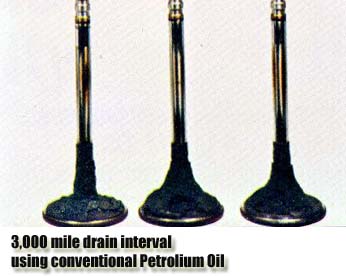
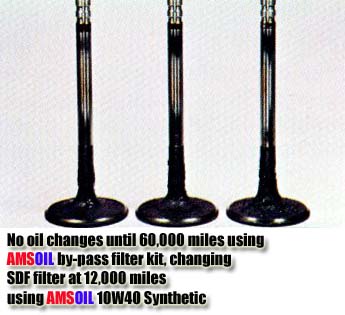
Arctic cat valves after using Amsoil Interceptor 2-cycle synthetic motor oil
No carbon deposits are detectable in the functioning region of the exhaust power valves, resulting in "no stick" performance, continuous valve operation and reduced maintenance.

Arctic cat pistons after using Amsoil Interceptor 2-cycle synthetic motor oil Arctic cat cylinder heads after using Amsoil Interceptor 2-cycle synthetic motor oil
Pistons show no scoring, little or no wear and no heavy deposits, and wrist pins show no discoloration from heat. In fact, the original machine markings on the pistons are still visible. Cylinder head is clean with no deposits, preventing pre-ignition problems.

TYPICAL TECHNICAL PROPERTIES
Interceptor Synthetic 2-Cycle Oil - Product code AIT
Kinematic Viscosity @ 100°C, cSt (ASTM D-445)
7.6
Kinematic Viscosity @ 40°C, cSt (ASTM D-445)
38
Viscosity Index (ASTM D-2270)
173
Pour Point °C (°F) (ASTM D 97)
-48 (-54)
Flash Point °C (°F) (ASTM D 92)
80 (176)
Fire Point °C (°F) (ASTM D 92)
80 (176)
ASTM Brookfield Viscosity @ 40°C (°F)
12400 cP
SAE Fluidity/Miscibility
#4

Information about 2-cycle engines

Two-cycle engines can be found nearly everywhere these days. They are used in dozens of applications and in a wide variety of designs for everything from work and recreation to power generation. Two-cycle engines have design differences and operate under conditions that require different oil chemistries than their four-cycle counterparts. In order to recommend a lubricant for a two-cycle engine, one needs to know how this engine operates, why it is used in place of a four-cycle engine and where and in what type of applications it is used.

What is a two-cycle engine?

The terms "two-cycle" and "two-stroke" are often inter-changed when speaking about two-cycle engines. These engines derive their name from the amount of directional changes that the pistons make during each power stroke. Internal combustion engines are used to produce mechanical power from the chemical energy contained in hydrocarbon fuels. The power-producing part of the motor's operating cycle starts inside the motor's cylinders with a compression process. Following this compression, the burning of the fuel-air mixture then releases the fuel's chemical energy and produces high-temperature, high-pressure combustion products. These gases then expand within each cylinder and transfer work to the piston. Thus, as the engine is operated continuously, mechanical power is produced. Each upward or downward movement of the piston is called a stroke. There are two commonly used internal combustion engine cycles: the two-stroke cycle and the four-stroke cycle.

How are two-cycle engines different from four-cycle engines?

The fundamental difference between two-cycle engines and four-cycle engines is in their gas exchange process, or more simply, the removal of the burned gases at the end of each expansion process and the induction of a fresh mixture for the next cycle. The two-cycle engine has an expansion, or power stroke, in each cylinder during each revolution of the crankshaft. The exhaust and the charging processes occur simultaneously as the piston moves through its lowest or bottom center position.

In a four-cycle engine, the burned gasses are first displaced by the piston during an upward stroke, and then a fresh charge enters the cylinder during the following downward stroke. This means that four-cycle engines require two complete turns of the crankshaft to make a power stroke, versus the single turn necessary in a two-cycle engine. In other words, two-cycle engines operate on 360 degrees of crankshaft rotation, whereas four-cycle engines operate on 720 degrees of crankshaft rotation.

Where are two-cycle engines used?

Two-cycle engines are inexpensive to build and operate when compared to four-cycle engines. They are lighter in weight and they can also produce a higher power-to-weight ratio. For these reasons, two-cycle engines are very useful in applications such as chainsaws, Weedeaters, outboards, lawnmowers and motorcycles, to name just a few. Two-cycle engines are also easier to start in cold temperatures. Part of this may be due to their design and the lack of an oil sump. This is a reason why these engines are also commonly used in snowmobiles and snow blowers.

Some advantages and disadvantages of two-cycle engines

Because two-cycle engines can effectively double the number of power strokes per unit time when compared to four-cycle engines, power output is increased. However, it does not increase by a factor of two. The outputs of two-cycle engines range from only 20 to 60 percent above those of equivalent-size four-cycle units. This lower than expected increase is a result of the poorer than ideal charging efficiency, or in other words, incomplete filling of the cylinder volume with fresh fuel and air. There is also a major disadvantage in this power transfer scenario. The higher frequency of combustion events in the two-cycle engine results in higher average heat transfer rates from the hot burned gases to the motor's combustion chamber walls. Higher temperatures and higher thermal stresses in the cylinder head (especially on the piston crown) result. Traditional two-cycle engines are also not highly efficient because a scavenging effect allows up to 30 percent of the unburned fuel/oil mixture into the exhaust. In addition, a portion of the exhaust gas remains in the combustion chamber during the cycle. These inefficiencies contribute to the power loss when compared to four-cycle engines and explains why two-cycle engines can achieve only up to 60 percent more power.

How are two-cycle engines lubricated?

Two-cycle motors are considered total-loss type lubricating systems. Because the crankcase is part of the intake process, it cannot act as an oil sump as is found on four-cycle engines. Lubricating traditional two-cycle engines is done by mixing the oil with the fuel. The oil is burned upon combustion of the air/fuel mixture. Direct Injection engines are different because the fuel is directly injected into the combustion chamber while the oil is injected directly into the crankcase. This process is efficient because the fuel is injected after the exhaust port closes, and therefore more complete combustion of fuel occurs and more power is developed. Direct injection engines have a higher power density than traditional two-cycle engines. Because the oil is directly injected into the crankcase, less oil is necessary and lower oil consumption results (80:1 range). Direct Injection motors have higher combustion temperatures, often up to 120°F. They also require more lubricity than traditional two-cycle motors.

Found on News Group about this oil:
"I have used the oil and found it to be good....I also used it in a 2003 REV 800 and had no issues. This year I switched to AMSOIL interceptor oil and it is just as good or better and is much cheaper. The claims that BLUE MARBLE make about RPMs and Mileage gains were unrealized by myself...As a matter of fact, I think that my mileage went up after switching to AMSOIL with absolutely no change in RPM from the BLUE MARBLE oil. I got a PREFERRED CUSTOMER # from AMSOIL and am paying $122.00/4-4L jugs ($31.00/4L or 7.75/Liter). I would recommend the AMSOIL, the WSA having it as the official oil can't be a bad thing. Hope that helps, if you want more info, remove the NO SPAM in the email address and drop a line, I could give you the REPs name and number for the AMSOIL (DO NOT pay retail!!!!) Cheers!!!"

Learn more about Amsoil products today!
Get your complimentary Factory Direct AMSOIL product catalog & info kit

Your information is kept confidential. Data is never sold or given to anyone.

1. Company: (Optional)
2. First name:
3. Last name :
4. Address :
Address (continued):
5. City:
6. State or Province: Zip:
7. Country:
8. Phone: (Area code + phone #... xxx-xxx-xxxx)
9. Your email address:
10. Have you used AMSOIL products before?

Do you know a local dealer in your area that sells Amsoil?
(i.e. such as a friend, relative, local store, etc)

If yes, are you planning to order through this dealer?
Who is the dealer?
11.

12. To help serve you better, please describe the year, make, model and engine size of the vehicles or machinery you wish to use Amsoil products:

Please check what applies to you (optional):

Dealership Option #1
Please send me a dealership application with my catalog so I can be a home AMSOIL dealer (i.e. getting dealer discounts, selling to friends, relatives, businesses or car clubs using small quantities or no inventory, etc.) ($30/yr. dealership fee applies) Serious inquiries only please.
Dealership Option #2

I want to keep a large inventory of AMSOIL products on hand to sell to the public for people who walk into my store or I have a shop that performs oil changes and wish to sell the 7,500 mile oil. (Typically: Quick lubes, small auto parts stores, high performance shops, motorcycle shop, boating or marine supplies store, etc)
Includes optional credit application.
No minimum order requirements.
Note: Legal corporation and Public Access storefront required
.

High Quantity Commercial Usage/Consumption
I want to save money with AMSOIL in a commercial environment and need to use large quantities (typically 30 or 55 gallon drums) for my company or government (i.e. trucking fleet, rental car agency, police department, landscaping or other establishment using numerous vehicles or equipment) and other areas. I would probably need hundreds or thousands of quarts per year and wish to get wholesale pricing for this volume.
Includes optional credit application.
Oil is for consumption and not for resale.
No minimum order requirements.
Note: Legal corporation required
.


HomeCarsBoatsMotorcyclesRV'sSnowmobilesImportant ArticlesTestimoniesAbout AmsoilLinksFAQFree Catalog

Authorized Amsoil National Dealer for Synthetic Motor Oil
Robert Riley
© 2003-2008 Robert Riley