In USA or Canada, order by phone at: 1 (800) 956-5695 Important: Give operator referral # 1102880
Putting AMSOIL to the test using New York City Taxi Cabs
Lubrizol, the prestigious specialty chemical
supplier, launched an ambitious testing program for its
additives and formulations. It involved finding a fleet
whose normal use exposed the cars to a wide range of stress.
One by one, the existing engines would be removed, and
replaced by factory new engines. Completing the tests,
the fleet's new engines would be removed and disassembled
for inspection.
The fleet chosen was made up of New York City taxicabs.
Here was a pool of automobiles subject to long periods
of idling, strenuous bouts with traffic, and an occasional
"follow that car!". Or "get me to the airport
no matter what," accompanied by the full range of
weather and temperature variables. A classic choice in
field testing.
But there were other factors the testers couldn't anticipate.
Once the tests began, an astonishing rate of smashed and
disabled cabs emerged. The test fleet seemed to ricochet
through the New York streets like billiard balls. Added
to this was the Chevrolet 229 CID V-6, an engine in its
last product year and remembered foundly by mechanics
everywhere for its ability to produce income.
Like all field tests, real-life testing would provide
something the laboratory never could. Unpredictability.
Welding
The Plugs
The AMSOIL test involved sixteen cabs divided into
four groups of four cabs each. The first four were controls.
Using the same petroleum oil and filters already in use
by the fleet, they would follow the existing fleet custom
of changing oil every 3,000 miles. They are identified
as "Group A".
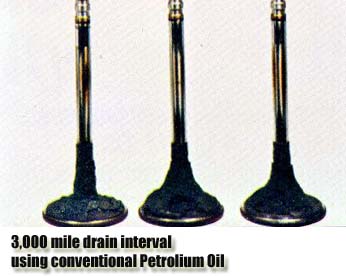
Group A, Unit 100: Control, Conventional Petroleum
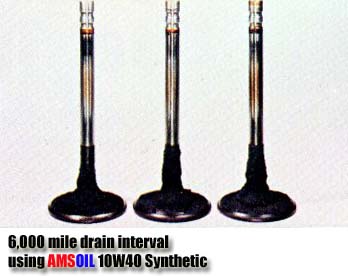
oil, 3,000-mile drain interval Group B, Unit 076: AMSOIL, 6,000-mile drain
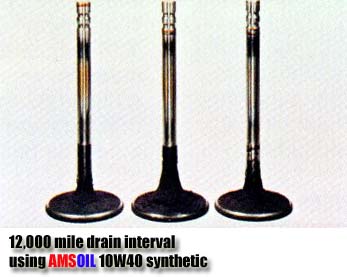
interval Group C, Unit 070: AMSOIL, 12,000-mile drain
interval Group D, Unit 074: AMSOIL, No oil changes, 60,000-miles
But "Group D" ran the ultimate test.
Using AMSOIL 10W-40
Synthetic Motor Oil, an AMSOILS Oil
Filter and AMSOIL By-Pass Filter (changing the filter
at 12,000-mile intervals), the taxis were "filled
for life". No oil changes at all. In fact, the drain
plugs were welded to the pan.
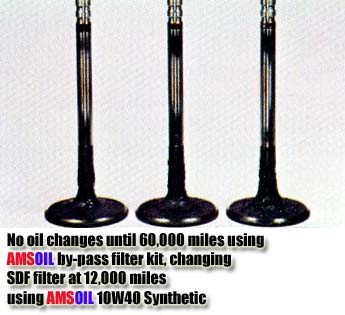
The life of the test was 60,000 miles. Overall, the AMSOIL
test fleet accumulated nearly three-quarter million miles.
Inside
The Engines
With
the tests completed and the engines removed and disassembled,
there was no visible evidence that an AMSOIL-filled engine
without an oil change in 60,000 miles was worse off than
a cab with 20 petroleum oil changes. A systematic analysis
of sludge, varnish, rust, and wear showed little variation
between taxis with AMSOIL products and those without,
even though AMSOIL oil change intevals ranged from double
to twenty times the petroleum-filled engines.
In its written conclusions, the testing facility responsible
for compiling the test data made this observation:
"The data presented in this report indicates that
AMSOIL synthetic SAE 10W-40 passenger car motor oil formulation
as desribed here provided protection of test engines from
excessive wear and deposit formation far beyond the normal
3,000-mile change interval."
In a separate letter to AMSOIL's Technical Director,
the testing facility diplomatically touched on the problems
caused by using the Chevrolet engine for testing, while
agreeing with the long-drain conclusions produced by AMSOIL
Synthetic Oils:
"I believe the general conclusion that your 'four
times normal drain' engines appeared as clear as our mineral
oil 'normal drain' engines is testimonial to your oil,
in spite of the unanticipated severity of the General
Motors 3.8 liter engine."
Adding It Up
In the end, the long, grueling test, so riddled with the
unpredictable events of real-life, pointed to a product
vastly better than ordinary petroleum. It established
base-line data that supported AMSOIL recommended drain
intervals of 25,000 miles or one year. It gave
visible evidence of how AMSOIL Synthetic Oil behaved in
the worst of circumstances. And it established the role
of the company's synthetic lubricants in the looming age
of conservation and environmental awareness.
For those who used their vehicles to make a living, it
promised a way to make the vehicle last longer, have fewer
down hours for general maintenance, and a way to increase
the profitability of their business.
N.Y.C.
Field Test Deposit and Wear
Sludge*
Deposits
Varnish*
Deposits
Rust*
Deposits
Cam + Lifter
Wear
Control Group: Petroleum 3,000
Mi. Oil/Filter Change
9.5
6.1
10.0
.02-.06"
Group B: AMSOIL Synthetic 6,000
Mi. Oil/Filter Change
9.6
7.0
10.0
.01-.03"
Group C: AMSOIL Synthetic 12,000
Mi. Oil/Filter Change
9.4
7.1
10.0
01-.03"
Group D: AMSOIL Synthetic
Fill for Life
9.5
6.6
10.0
.02-.05"
*10 = clean
Duration - 60,000
Miles on all vehicles
North
Dakota taxie fleet recognizes savings and benefits of their
ten-year relationship using AMSOIL
With over a hundred vehicles on the road, each traveling
up to two-hundred fifty miles a day, a taxie fleet's office
manager has his hands full. For Al Wangler, office manager
of Schumacher Cab in Bismark, North Dakota, the responsibility
of such a huge operation is overwehelming, and any product
that spares him a few headaches and dollars makes his
work a lot easier.
Schumacher Cab carries a fleet of taxis, transit vehicles,
limousines and crew vans. They've been using AMSOIL Synthetic
Motor Oil, Automatic Transmission Fluid and Synthetic
Grease for over a decade, and they've had outstanding
results.
"We've saved thousands of dollars over the years,"
says Wangler. "But for me, the best part is the fact
that AMSOIL spares us a lot of hassle."
The company extends the drain intervals of its vehicles
to 24,000 miles, so they suffer a lot less vehicle down-time.
In addition to the time and money saved by the extended
drain intervals, Schumacher Cab has realized the great
long-term benefits of maintaining their vehicles with
high-quality AMSOIL lubricants. Wangler feels that the
lubricants have helped keep their vehicles on the road
longer:
"Our vehicles average about 200,000 miles. We've
even had some reach as high as 300,000 miles. In this
business, where the vehicles are used for some very hard,
very demanding city driving, such a long life-span is
exceptional. AMSOIL has saved us money by helping us get
more out of our vehicles."
And best of all, AMSOIL saves Wangler a lot of worry.
He knows that the company vehicles have the best protection
available to help them endure their brutal schedules.
Fewer maintenance problems result in less downtime and
fewer expenses for him to juggle in the company's daily
operation.
Schumacher Cab has used AMSOIL products for over ten
years, and they plan to continue their relationship with
AMSOIL. It's a relationship that benefits them a great
deal. It's a relationship that will continue to pay a
significant role in the success of Schumacher Cab.



 With
the tests completed and the engines removed and disassembled,
there was no visible evidence that an AMSOIL-filled engine
without an oil change in 60,000 miles was worse off than
a cab with 20 petroleum oil changes. A systematic analysis
of sludge, varnish, rust, and wear showed little variation
between taxis with AMSOIL products and those without,
even though AMSOIL oil change intevals ranged from double
to twenty times the petroleum-filled engines.
With
the tests completed and the engines removed and disassembled,
there was no visible evidence that an AMSOIL-filled engine
without an oil change in 60,000 miles was worse off than
a cab with 20 petroleum oil changes. A systematic analysis
of sludge, varnish, rust, and wear showed little variation
between taxis with AMSOIL products and those without,
even though AMSOIL oil change intevals ranged from double
to twenty times the petroleum-filled engines.